The 13 Moon Calendar: Why It Still Resonates Today
Explore the idea of a thirteen-moon year, from lunar cycles and fixed calendars to the Day Outside Time — and discover why so many people are drawn to a different way of experiencing time.
In This Article
The Calendar We Inherited
A Year of Thirteen Moons
The International Fixed Calendar
The Day Outside Time
Linear Time and Cyclical Time
Final Reflection
The Calendar We Inherited
Most of us rarely question the calendar we use.
Some months contain 31 days. Others contain 30. February has 28, except when it has 29.
Weeks and months rarely align neatly, and the phases of the Moon drift quietly through the background of modern life.
Yet for much of human history, people experienced time differently.
Many cultures observed both the Sun and the Moon, noticing not only the changing seasons but also the recurring rhythm of lunar cycles. Looking up at the night sky, they recognized something remarkable:
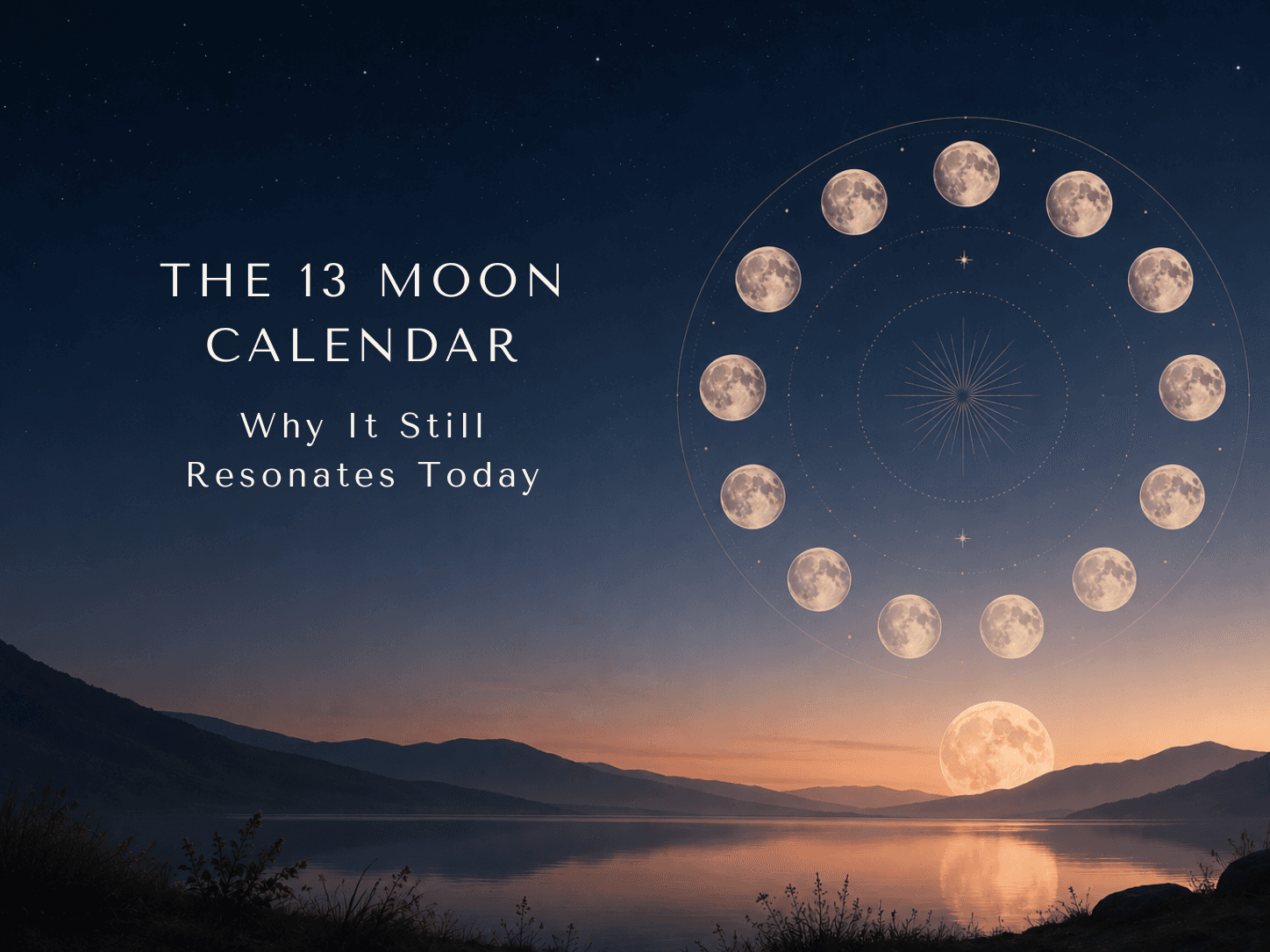
A solar year contains almost exactly thirteen lunar cycles.
This simple observation has inspired different calendars, traditions, and ways of thinking about time.
Perhaps the most interesting question isn't whether a thirteen-moon calendar is more accurate.
It's why so many people continue to be drawn to it.
A Year of Thirteen Moons
A complete lunar cycle lasts approximately 29.5 days. Over the course of a solar year, this creates roughly thirteen complete moons.
Across history, different cultures and modern traditions have explored ways of organizing time around this natural rhythm.
One of the distinctive features of many modern 13 Moon Calendars is that each lunar cycle is associated with a symbolic theme. Rather than treating every month as interchangeable, each Moon becomes an invitation to reflect on a different quality or stage of the journey through the year.
Magnetic Moon — attraction and purpose
Lunar Moon — challenge and polarity
Electric Moon — movement and activation
Self-Existing Moon — form and definition
Overtone Moon — empowerment and radiance
Rhythmic Moon — balance and organization
Resonant Moon — attunement and intuition
Galactic Moon — integrity and harmony
Solar Moon — intention and realization
Planetary Moon — manifestation and growth
Spectral Moon — release and liberation
Crystal Moon — cooperation and sharing
Cosmic Moon — presence and completion
Whether you see these names as spiritual symbolism or simply as prompts for reflection, they shift the focus away from measuring time and towards experiencing it. Instead of asking "What month is it?", they encourage us to ask, "What season of growth, balance, or release am I moving through?"
In recent decades, modern spiritual movements have helped popularize thirteen-moon calendars, often blending inspiration from ancient traditions with contemporary symbolism. Whether taken literally or simply as a reflective framework, their enduring appeal lies in the invitation to experience time more consciously.
The International Fixed Calendar
The idea of thirteen months has also appeared outside spiritual traditions.
In 1902, British accountant Moses Cotsworth proposed the International Fixed Calendar—a practical attempt to simplify the way the year was organised.
His system divided the year into thirteen months of exactly twenty-eight days, with an extra day outside the regular weekly cycle to complete the solar year.
The goal was not symbolism, but consistency.
It shows that the idea of thirteen months has inspired both practical reforms and more reflective ways of understanding time.
The Day Outside Time
Many thirteen-month calendars include an extra day that belongs to no week and no month.
A pause between cycles.
A threshold rather than a destination.
Some modern traditions call it the Day Outside Time.
Whether observed ceremonially or simply appreciated as an idea, it reminds us that transitions deserve space.
Not for productivity.
Not for planning.
Simply for noticing what has ended before stepping into what comes next.
Linear Time and Cyclical Time
Modern life often teaches us to think of time as a straight line.
Deadlines.
Schedules.
Progress.
Nature tells a different story.
The Moon waxes and wanes.
The seasons return.
Seeds rest before they grow.
Trees blossom, bear fruit, and become bare again.
Life unfolds through cycles of activity, stillness, change, and renewal.
Perhaps we do too.
This may be the reason the idea of a thirteen-moon calendar continues to resonate with so many people.
Not because it replaces the calendar on our wall.
But because it reminds us that time can be experienced as something living—something we move with, rather than simply move through.
✧ Final Reflection
Whether or not you choose to follow a 13 Moon Calendar isn't really the point.
Its greatest invitation is simply to notice time differently.
To slow down.
To observe the rhythms of the Moon, the seasons, and your own life.
Calendars help us organize our days, but they also shape how we experience them.
Sometimes a different calendar doesn't change the year.
It changes the way we move through it.
Like the Moon, we, too, grow in phases.
Continue Exploring
If you're curious about lunar cycles and living more intentionally with the rhythms of nature, you may also enjoy:
✦ Explore Further
If you'd like to deepen your understanding of the Moon's cycles, the Birth Moon Reflection Guide explores the symbolism of every lunar phase through guided reflections, journaling prompts, and simple rituals.
Move with intention. Follow the cycles.
Seasonal reflections, gentle rituals, and inspiration for intentional living.
Plus 10% off your first purchase.